
Housing NOW Bamboo Construction Manual
An open-source illustrated field manual that places bamboo-construction knowledge and design authority directly in the hands of the carpenters and communities who build with it
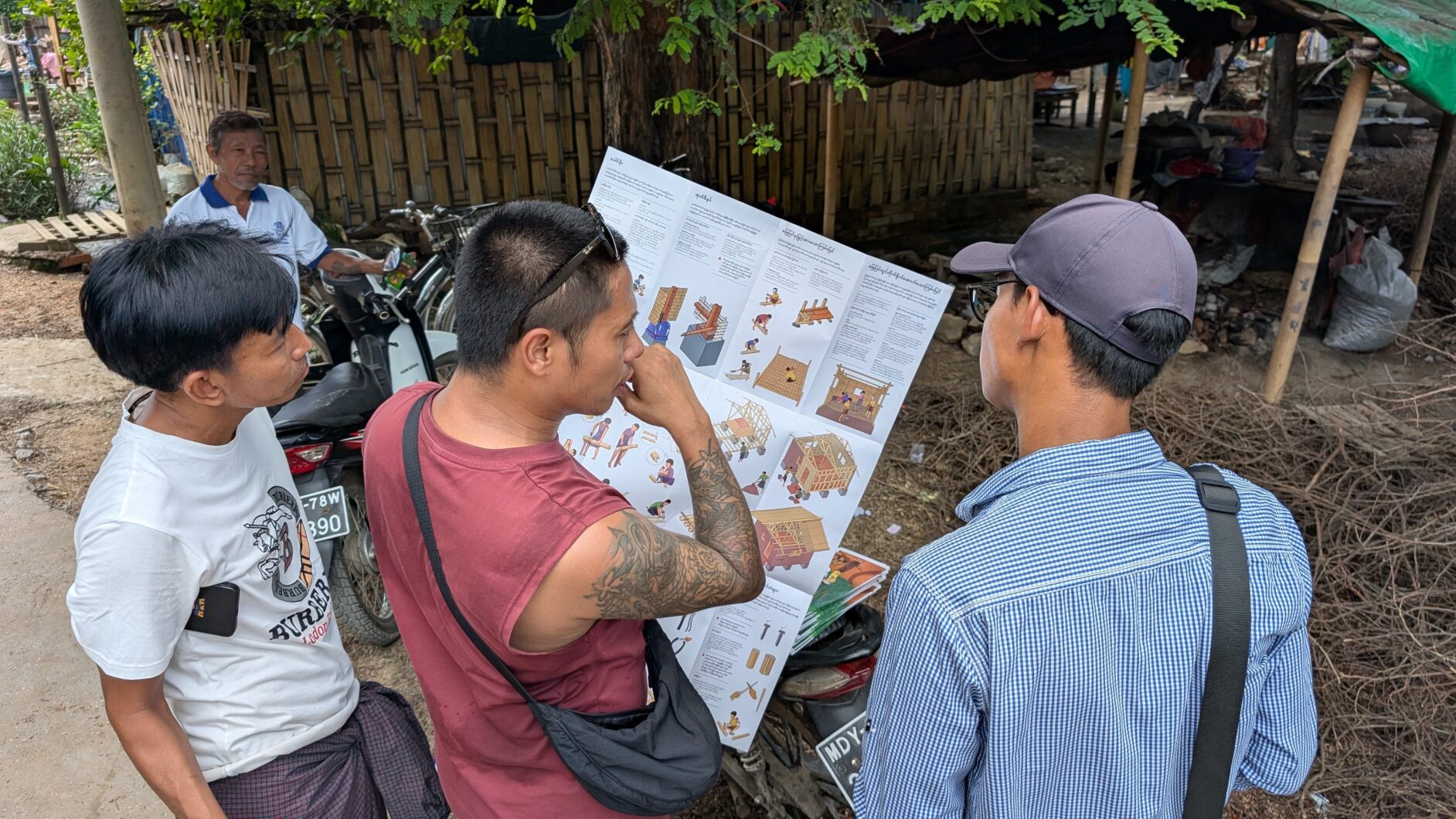 Manual distribution, Photo Courtesy Raphaël Ascoli
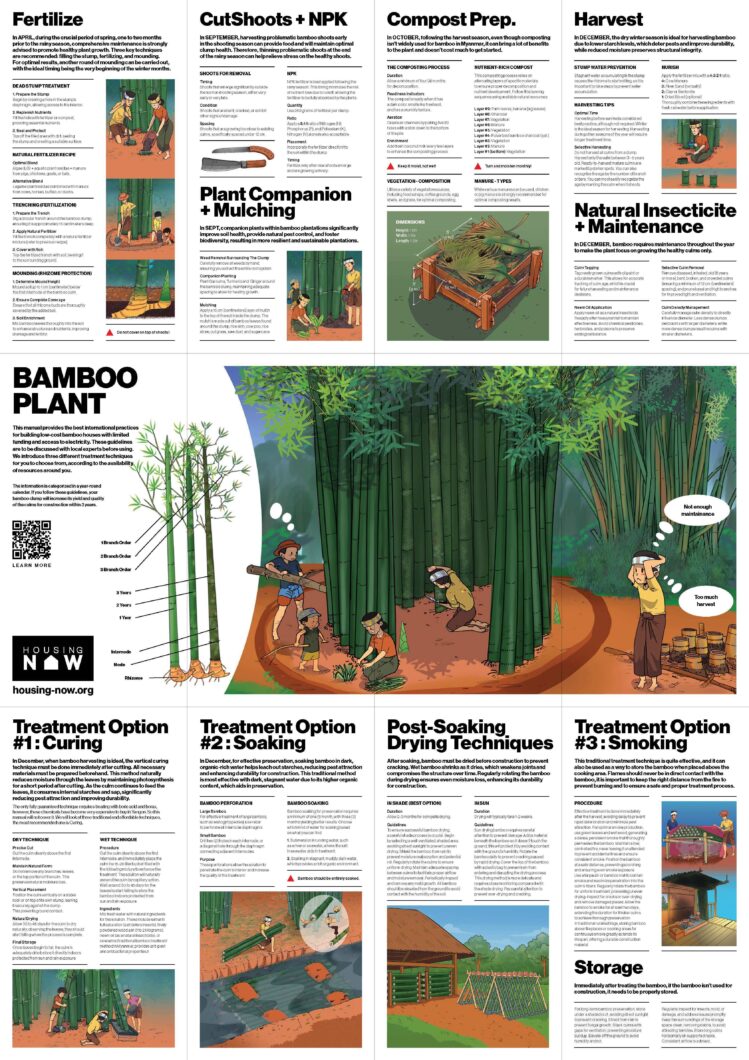 Blue Temple, Bamboo clump management
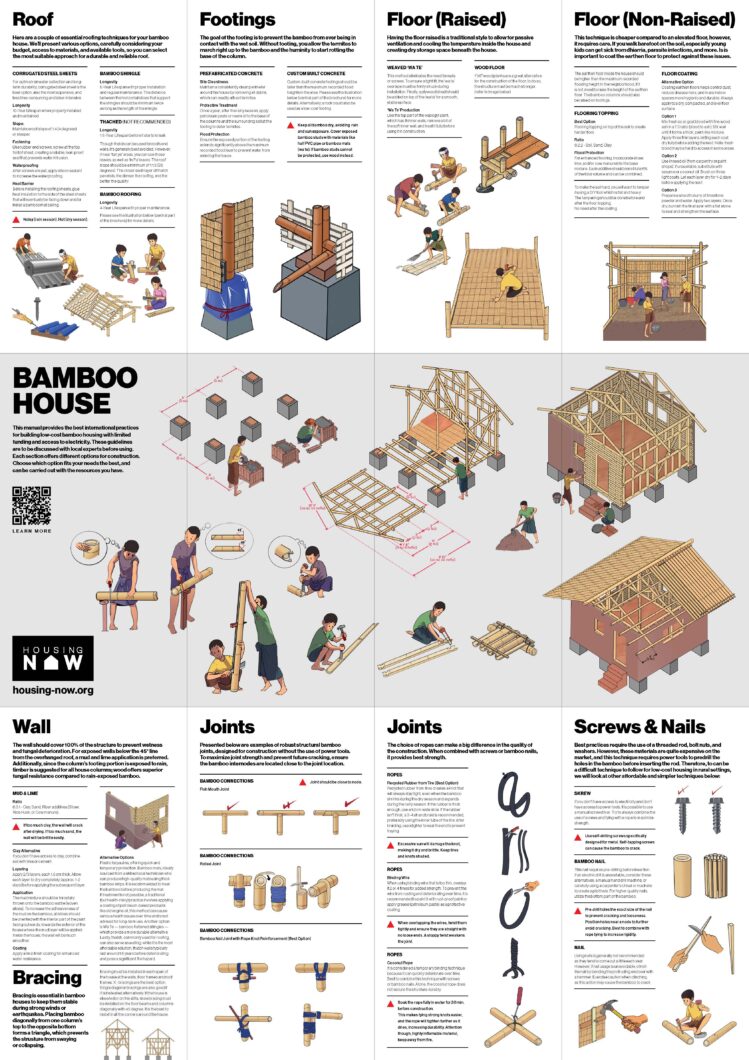 Blue Temple, Bamboo low-cost construction
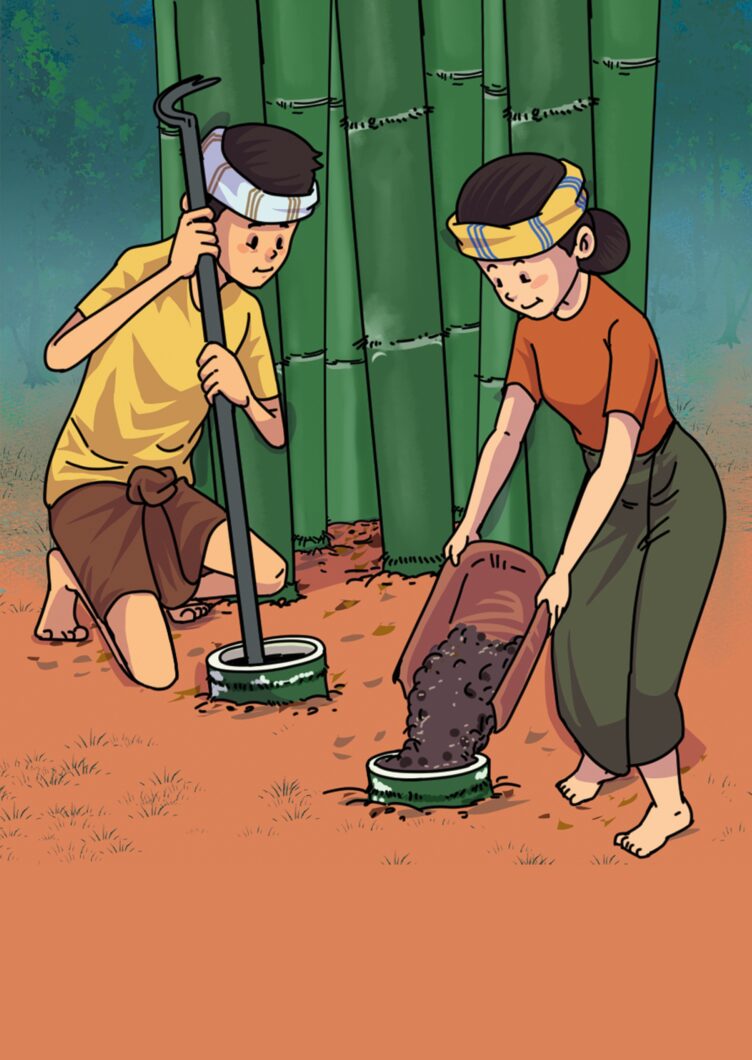 CreaNova, Manual Illustration
Initiator(s)
Housing NOW
Description
Created amid Myanmar's conflict, with about four million people internally displaced by July 2026, the Housing NOW Bamboo Construction Manual is an open-source, Burmese-language, two-sided A1 field tool for bamboo carpenters and communities rebuilding with limited electricity, tools, and specialist support. It rejects the standardized aid shelter. Illustration, typography, and folding turn technical knowledge into a shared low-tech interface: one side follows annual bamboo clump management; the other moves from footings to roof. Ten layouts were tested over six months. Illustrations by Myanmar illustrator Zu Zu Lwin Maung of CreaNova Creative Studio, with graphic design and layout by João Martins, show women, children, older people and men as participants; deliberately non-specific longyi patterns privilege no ethnicity. Central images show one possible clump and house, not an imposed design. Users select techniques according to local materials, funding, skills and climate. Art redistributes design authority: communities adapt, translate and build for themselves.
Goals
Transfer tested bamboo management and construction knowledge directly to Myanmar carpenters and communities; make it usable offline and without machinery or specialists; improve the durability, safety, repairability and ecological renewal of bamboo housing; represent building as inclusive community work; and shift design authority away from standardized humanitarian shelter systems. The goal is not to replicate one house, but to provide a locally adaptable method that users can translate, modify, and apply according to species, skills, budgets, climate, and supply chains.
Beneficial outcomes
Verified reach to date: 2,000 printed copies distributed across Myanmar through UNHCR and established humanitarian partners, plus unrestricted online access. Users gain a portable, offline reference spanning clump management, material treatment, construction, repair and maintenance. Its menu of techniques preserves local authorship and supports decisions based on available materials, skills and budgets. End-user adoption has not yet been quantified: conflict, weak connectivity and multi-stage delivery made conventional surveys ineffective, despite a Burmese feedback form and UNHCR-coordinated follow-up. We therefore distinguish proven access from unverified downstream impact—an honest, non-extractive evidence standard for work with high-risk communities.
The manual is distributed nationally through humanitarian networks, including those reaching displaced and conflict-affected communities.
Download HERE
Download HERE
Location
Myanmar
Users
Primary users are local bamboo carpenters, community builders, families, and displaced or vulnerable communities in Myanmar with existing knowledge of vernacular bamboo construction. The manual treats that knowledge as a foundation, not a deficit. Secondary users are local organizations and humanitarian partners that print, translate, and distribute it; they are delivery channels rather than the project's principal beneficiaries.
Maintained by
Housing NOW
Duration
2025 - ongoing
Category
Scientific
Pedagogical
Politics
Urban Development
Economy
Environment
Social
Links
https://www.housing-now.org/
https://www.worldbamboo.net/news-1/housi...
https://www.blue-temple.com/project/manu...


